

Peri peri…..menopause?
(far less delicious than Nando’s)

Hello all,
For 38 sweet naive years, ‘peri’ has meant only one thing to me - and the chicken fans among you will know what I’m talking about. But in this newsletter, I’m getting pretty personal and sharing with you my reluctant but unstoppable dive into the other peri….
That’s right, friends. I’m officially in perimenopause.
While nobody needs a dictionary definition for ‘puberty’ or ‘pregnancy’, this chapter of female physiology is so shrouded in mystery that you’d be forgiven for not really knowing what it means. In short, menopause defined as 365 days after a woman’s last menstrual period. And perimenopause is the run-up to that day: a season that can last years, and even decades.
But that is a very technical - and rather narrow - interpretation of it. Menopause and perimenopause is about so much more than ovulation and menstruation - it’s not just a neat transition from a woman being ‘fertile’ to ‘not fertile’. It’s messy, it’s uncertain, it’s chaotic, it’s a constant surprise. It’s finding yourself dumped on the threshold of a new, unknown, house, with no prior warning and with no choice but to walk through the front door.
So here’s the story of how I arrived there and how I’m (finally) starting to deal with it. I hope it might be helpful to you, or to someone you love, in navigating this hormonal wild west…
MISSING: one brain
I am sitting at my desk trying to write, but I just can’t focus. My brain feels as though it’s made out of wool: thick, unruly, ropey wool that I can’t control or tame or make sense of. I’ve always been a list maker: before, it was because I enjoyed the dopamine hit from ticking things off as I complete each task. Now, it’s because I will forget anything that isn’t written down.
I leave notes to myself all over the house:
SWIMMING BAGS
CHARGE LAPTOP
ORDER VEG
I forget words. One time I forget the word for ‘milk’. I stumble through conversations peppered with ‘thingy’ and ‘whatsitcalled’ accompanied by frustrated, searching hand gestures.
I am being betrayed by my own brain. It used to be the thing I could always count on: being smart, articulate, able to express myself, able to write, to verbalise. Words were my thing. Now I can barely string a sentence together.
I get through my book tours through sheer force of will, summoning every drop of energy on stage. After every ‘in conversation’ event, I worry if I actually made any sense. I take two or three days to recover after each one.
Over the course of several months, it gets even worse, to the point where I have to choose one thing each day to do. I can either cook for my family, or I can write. I can’t manage both. And whatever I do has to be before 12pm because after that, I am good for absolutely nothing. If I have a phone call scheduled, it is the only conversation I can hold that day. My texts go unanswered for longer than usual, it takes longer to reply to voice notes - something I used to enthusiastically look forward to doing.
I feel so guilty for being so useless. I make up games that involve me lying on the floor so that I can still at least play with my kids. We come up with Ammu-is-a-road (they wheel cars up and down my back); Ammu plays various boardgames but lying down; Ammu-is-a-baby (they pat me to sleep - this one is great for the 5 seconds I am ‘asleep’ before WAKE AAAHP AMMUUUUU is bellowed into my face.
It’s not just my brain, it starts showing up in my body too.
Just a body that I used to know…
When things creep up on you, it’s hard to see how abnormal it is….over the course of about 18 months, I slowly get used to a litany of weird physical symptoms that seem to come out of nowhere: joint pain first thing in the morning, a perpetually aching neck and shoulder, digestive issues, sensitivity to noise, extremely dry skin and hair... These are the symptoms I can do my best to hide. But what I can’t hide is what becomes increasingly apparent when I see myself in the mirror: a rapid and seemingly uncontrollable ballooning of my body.
Weight seems to race towards my face and my abdomen and make itself firmly at home there. It won’t budge, despite my efforts - I train with a personal trainer, I am careful with what I eat, but even though my fitness improves, my body shape seems to have changed. While never ‘slim’, I used to at least go ‘in and out’. Now, I look in the mirror and see a barrel. A grumpy, foggy-brained barrel.
I miss my brain so much. I miss my body so much. I miss myself.
NFLM
‘Not Feeling Like Myself’ or NFLM has become an acronym for one of the earliest symptoms for perimenopause. I wish someone had told me that this feeling - described brilliantly in this article - was something to keep an eye on.
Instead, I experience this for months and months, before I am suddenly hit by a more ‘classic’ symptom of perimenopause: one that I have heard of. I am standing at the sink doing the dishes and I get the sensation of something creeping up my neck and onto my scalp and then my entire head starts sweating. I feel the little drops run down the back of my neck and into my ears and I’m astonished - is this really happening?
It occurs a few times over several weeks. At one point, I ring my mum up and ask her what a hot flush feels like. I describe what happened to me, and she suggests that I might have just had one.
This confirmation gives me the push I need to try and seek medical help - a task that sounds much easier than it is….
The doctor(s) will see you now…
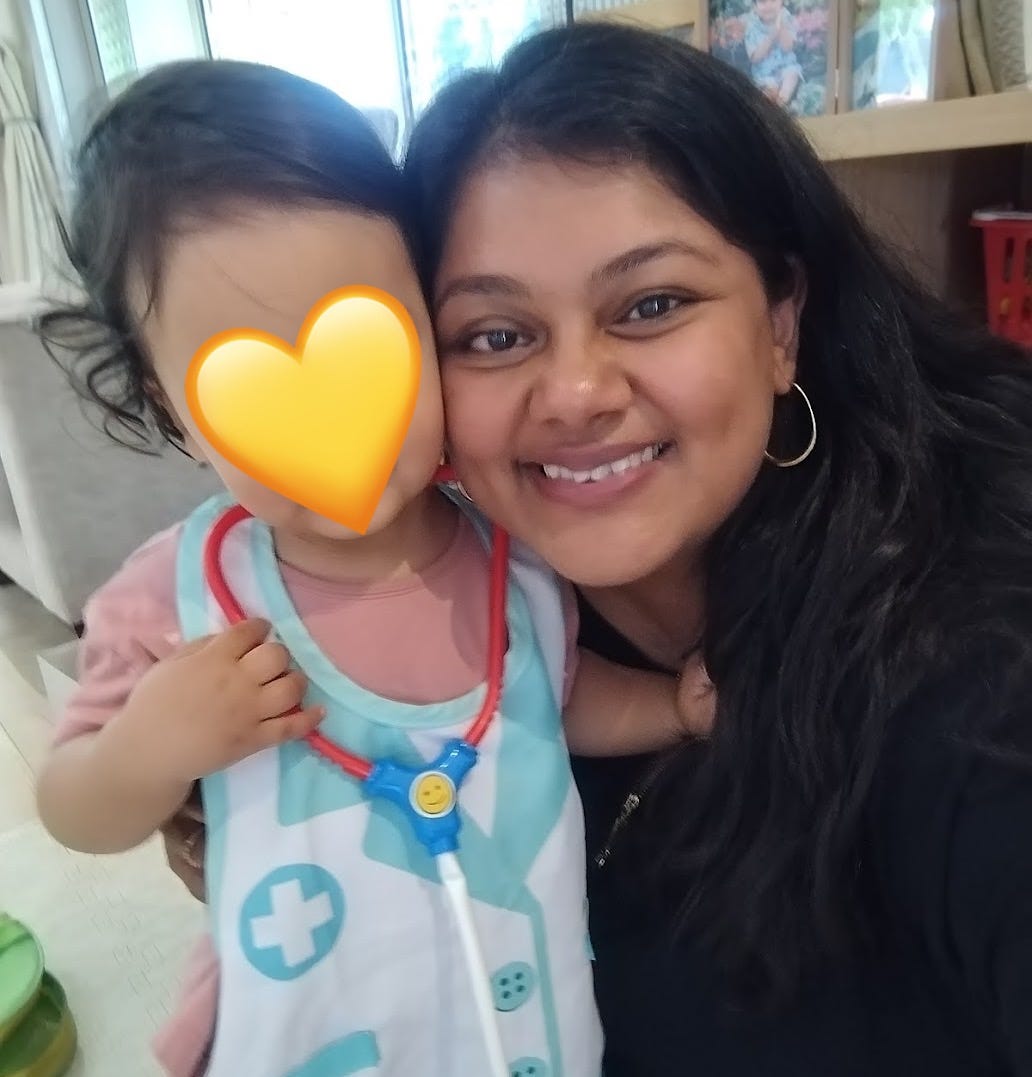
Over the course of 9 months I see no fewer than four doctors in three countries. There is the lovely German doctor in Zimbabwe who is very kind but refuses to believe that I am perimenopausal because I am ‘too young’. Then there is the Pakistani OBGYN in Rwanda who suggests that I’m just tired because that’s just what having young children is like, and have I considered losing weight?
After a long wait, I see a consultant endocrinologist in the UK. I am fortunate to have been referred by the NHS for my pre-existing PCOS which I’ve navigated for my whole adult life. But things have shifted. I am feeling so insecure that I ask Avi to accompany me. The doctor listens sympathetically as I recount my symptoms which read like a laundry list from the NHS page on (peri-)menopause:
I can’t sleep properly. I wake up tired. I’m forget my words. I don’t remember why I walked into a room. Everything feels like too much. My knees hurt. My ankles hurt. My shoulder hurts. My periods are insane. I have no drive. I’m gaining weight despite exercising and eating carefully. I keep getting UTIs. I’m having palpitations. I get hot flushes. My skin is dry. My hair is dry. I’m getting frequent headaches. And I have rage blackouts where I get so angry I genuinely cannot see properly…
I’m conscious of sounding like a ‘Mrs Bibi’ or ‘Mrs Begum’. But now I know why ‘Mrs Bibis’ present in the way they do. Nobody bloody listens to them.
I ask the doctor straight if this is perimenopause. He’s too embarrassed to even say the word.
‘You could be…going through….The Change,’ he acknowledges. But he’s more interested in testing me for various syndromes that I am certain I don’t have. He suggests that I….lose weight. So glad that I waited almost a year for that cutting edge piece of medical advice. I feel like I’m banging my head against a very deaf, very established wall. What if, for once, a doctor would look at my weight and see it as a symptom - and one of MANY - rather than a cause?
What if for once, someone would actually listen to what I’m telling them?
Last ditch attempt….
I’m sitting at my laptop, on a call with a private GP in the UK. Dr Natalie Summerhill is a certified menopause practitioner based in Manchester who I have found online. I am fortunate to be able to pay this out of pocket - it costs £275 for this virtual consultation. I have sent Dr Summerhill the same recent blood test results and my recent vitals that all the other doctors have seen. Like the others, she asks me to describe my symptoms. Unlike the others, she actually listens.
‘Are you a medic?’ she asks when I have finished talking.
‘No, I’ve just done a lot of research. And I’m really tired of being fobbed off.’
‘I am so sorry you have been going through this and that nobody has helped’, she tells me. ‘It’s not right.’
We look at my blood test results. While shocking, the results are far from surprising.
Over the last 9 months my oestrodial (a form of oestrogen) levels have plummeted from already lower than normal to barely existent. That would explain the fatigue, the aching joints, the palpitations, the headaches, the mood swings…
My testosterone levels also sit well below the lowest normal levels for women. That would explain the brain fog, the inability to concentrate, the overwhelm, the total loss of any kind of drive, the desire to just stay home and never leave.
And the whole glorious cocktail of hormonal imbalances, it turns out, are contributing to my iron deficiency anaemia, my rock-bottom Vitamin D levels, and the IBS diagnosis I received last year, on top of everything else.
There’s no question, Dr Summerhill confirms. You are in perimenopause. And we can help you.
My relief is hard to express. It’s like a very heavy, very dark cloud has lifted. All the stories I have been telling myself, about myself, for the last year or so aren’t true.
I’m not stupid.
I’m not lazy.
I’m not greedy.
I’m not inept.
I’m not a bad-tempered harridan
I am perimenopausal.
And none of these symptoms - the stuff I have worked SO HARD to try and fight - are my fault.
It’s not my fault.
Hope in a box
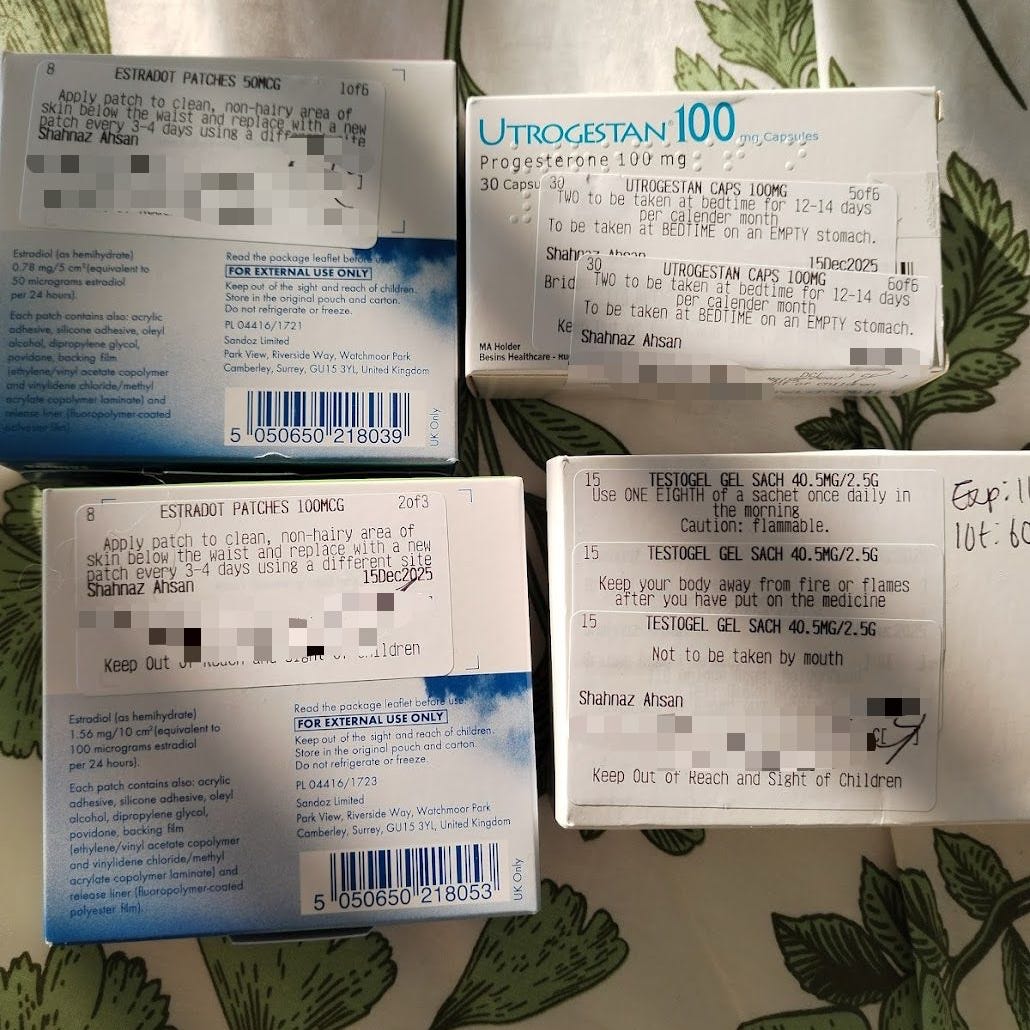
Dr Summerhill prescribes me an oestrogen patch, progesterone capsules and a testosterone gel that I can start using once I’ve established the oestrogen and progesterone therapies. I can barely wait til we get home from the pharmacy: I tear open the paper bags in the car. There are so many boxes. Boxes containing something I have missed for so long: hope.
Within a few days of wearing the Estrodot patch, my joint pain has gone. I feel more….resilient somehow? My mood is lighter, I have more patience. I am shocked - I didn’t expect to feel the efforts quite so quickly. I march into the kitchen and cook a feast of shepherd’s pie (one keema, one lentil and bean, and two types of salad). Before this, I could barely scrape together a toasted sandwich without needing a lie down. I am slow to change my patch one day, and notice my mood plummeting - I realise how very real these hormonal effects are. How much they have, and continue to, govern every aspect of my life.
Joining the club
I start seeing perimenopausal women everywhere I look:
Like the brusque, impatient cashier at the pharmacy who is giving zero f*cks the day I go in to collect the rest of my prescription. There is some drama: first they think it has arrived, then it hasn’t, then I panic - I am flying the next day - and then finally they find it.
Phew, I say. She glances at the box and gives me a knowing nod, her whole demeanour shifting. Bless you, she says. Yes, phew.
I see perimenopausal women from my past too. The generations of South Asian women who complained that their bodies were falling apart, because they were, and who - instead of being given help, were given a mocking collective name, Mrs Bibis, by the medical community that was supposed to help them. And even when they did finally get help, it was shrouded in so much shame and fear that many of them discontinued their treatments.
I remember watching my grandmother taking a fistful of pills everyday when she was probably in her late 40s (she was a very young grandmother). One day I asked her what they all were. She pointed to each one: this is cod liver oil, this one is garlic oil, that’s a multivitamin, this one is for my blood pressure, this one is HRT…’
‘What’s HRT?’ I remember asking.
‘HRT is HRT,’ she snapped.
She stopped taking it soon after that, worried about the effects it could have on her later health. There is lots of scaremongering about HRT. But newer studies have shown that hormone therapy in perimenopausal and menopausal women has been found to be preventative against declining cardiovascular health, bone density, diabetes, and even dementia. I’ve done my research - if you’re considering it, then do yours too - but the study that linked HRT to increased breast cancer risks has now been debunked - much like that MMR/autism study.
Stuff nobody tells you, but could literally save your life. And make it feel worth living.
Learning curve
Newly empowered, I am constantly learning. My YouTube algorithm is a carousel of women’s health content: I listen intently while doing the dishes, or doing my steps on the treadmill. I am piecing together parts that I didn’t even know made up the same puzzle:
My clicking ankle and my suddenly wavy textured hair? Peri-menopause!
My overwhelming hatred of TV shows with lots of background noise? Peri-menopause!
My inexplicably bleeding gums and dry skin? Peri-menopause!
My fluttering heart palpitations and creeping cholesterol levels? Peri-menopause!
My reluctance to leave the house after 3pm? Peri-menopause!
I am just staggered by how all encompassing it all is. It affects every. single. part. of a woman’s body and brain. It affects our relationships. Our friendships. Our work. My poor babies, having had to deal with a listless, impatient mother for so long. Poor Avi, who somehow resisted issuing ‘MISSING’ posters for the artist formerly known as his not-insane wife.
But in the thrill of finally having a reason for feeling like absolute crap for over a year, I am thrown by one very significant bump. Painted on it in thick letters is: GRIEF.
I fall and smack my face right into it.
How is this happening already? After the excitement of having an answer, I feel cheated, somehow. Cheated out of my….youth? I am in this weird, in-between stage of life. No longer a glossy-haired, smooth-skinned young woman; not yet a silver-crowned wise elder. Just a slightly-less-grumpy-than-before barrel who is trying to make sense of a new physiology.
The gap between postpartum and perimenopause has been so short for me. Just 2 years. I wanted a bit more time: time to just be is how I describe it to my therapist. Not to worry about pregnancy or healing, or ageing or declining. Just time to be me. When I remarked that I don’t have a ‘community’ of women experiencing the same things that I am - my therapist suggested that I build one.
The start of what’s next….
So that’s sort of what I am, nervously, trying to do. Many of my peers aren’t quite there yet - 38 is on the young side to be ‘diagnosed’ but not especially young to be feeling the effects. But if you’ve read this far in the newsletter, and if you, or a woman you love, is going through this - and you would like to reach out, I would love to hear from you.
Talking openly about these things is what saved me. My own mother breaking generations of silence around it, and being open about her own journey, gave me the knowledge and the confidence to pursue medical help. If you’re hovering around the edges of these questions and want a little support, you aren’t alone (scroll to the bottom for some resources that helped me).
I’m sure I’ll be writing about this again…
With love and solidarity,
Shahnaz x
PS - as a thanks for reading this far, here is a great recipe from Bangla Rannaghor, one of the OG and best channels, for peri peri chicken and rice.
Recommended resources
Websites
British Menopause Society
The Menopause Charity
Menopause Matters
Menopause Care
Dr Louise Newson
Dr Louise Newson (@menopause_doctor)
Mary Claire Haver, MD Mary Claire Haver, MD
Jesse Robertson (@husbands4menopause)
Brooke | @marriageinperimenopause
Books/audiobooks
Estrogen Matters - Avrum Bluming, Carol Tavris
The Menopause Manifesto -Dr. Jennifer Gunter
The New Menopause and The New Perimenopause - Dr Mary Claire Haver
Podcasts/videos
Menopause Masterclass: Hormones, Brain Fog, Weight & Mental Health - Dr Mary Claire Haver
Dr Nighat Arif on BAME women and perimenopause
Dig In with Jo Whiley and Zoe Ball with Dr Naomi Potter
Hormone and fertility experts - Diary of a CEO (I know, I know - there’s a LOT to say about this podcast series but this conversation about peri was excellent)